
The Great Matchmaker: How Leorey Saligan is building connections to advance nursing science at Rutgers
Summer 2026
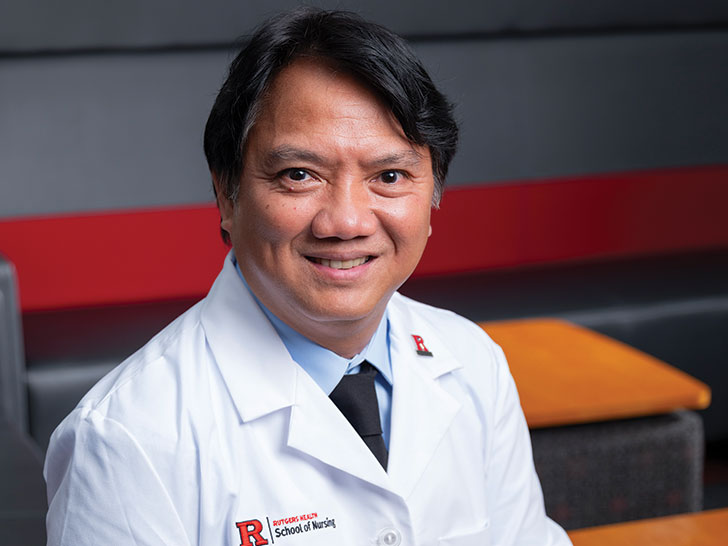
Leorey Saligan, PhD, RN, CRNP, FAAN, believes that alone we are smart—but together we are brilliant. Guided by that credo, he is uniting researchers, ideas, and resources as professor and inaugural vice dean of research at Rutgers School of Nursing.
Saligan, a nationally certified family nurse practitioner, joined the school last fall as an adjunct professor and stepped into the vice dean role in February 2026.
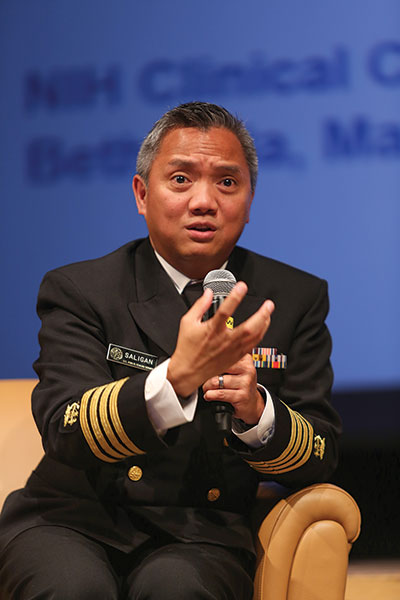
Before that, he spent 20 years at the National Institutes of Health (NIH)—most recently as a tenured senior investigator. Concurrently, he served in the United States Public Health Service Commissioned Corps, stationed at the NIH, before retiring as a captain.
Driven by Experience
His research investigates persistent cancer-related fatigue and related symptoms—cognitive impairment, pain, and sleep disturbances—to improve quality of life for cancer patients, survivors, and their families.
This focus is profoundly informed by his time as the caregiver for both parents during their cancer treatments. “I supported my mother through a mastectomy complicated by infection, followed by radiation and multiple rounds of chemotherapy,” he says.
“Then I cared for my father,” Saligan continues, “as he underwent radiation without hormone therapy because of his heart condition. These experiences deeply shaped my commitment to advancing the science of supportive cancer care so that other caregivers can better navigate the challenges.”
Saligan began asking: “What does ‘my tank is empty’ mean biologically?” Focusing on mitochondrial function—the body’s energy source—his team discovered and patented biomarkers for chronic fatigue, which affects nearly 4 million Americans. “Most people don’t grasp the depth and severity of how intrusive and debilitating that is.”
In February 2026, Saligan published a proof-of-concept study on ketamine’s ability to boost the body’s energy stores. “We found almost a 39% increase in the first 24 hours. That’s very exciting.” Next, he will determine the optimal dose to maximize benefits while ensuring safety.
He believes the approach could help patients re-engage with strategies like regular exercise—jump-starting a positive cycle of recovery.
Service in Action
As an officer in the U.S. Public Health Service, Saligan led and provided care during emergencies and natural disasters, including mass shootings, hurricanes, and the Haiti earthquake. For its work in West Africa during the 2014 Ebola crisis, the service received a Presidential Unit Citation for extraordinary heroism. “We helped create the capacity to care for—and contain—that infection there,” Saligan recalls.
The honors have continued. In 2026, Saligan was inducted into Sigma Theta Tau’s International Nurse Researcher Hall of Fame. In 2024, he received the Outstanding Mentor Award from the National Institute of Nursing Research and the Outstanding Service Medal from the Office of the Surgeon General, U.S. Department of Health and Human Services.
“Recruiting Dr. Saligan was monumental,” says School of Nursing dean Angela Starkweather. “He’s been leading nursing science, and he uniquely touches lives. He draws out what individuals find meaningful and then guides them through each step. To have him here at Rutgers is magical.”
Building Partnerships Across Disciplines
For Saligan, being a matchmaker means connecting people, ideas, and resources to accelerate discovery and drive change. “Over the years at the NIH, I built a consortium of early-career and mid-career researchers who have collaborated, creating standardized research outcomes and common databases that they use to publish papers and apply for grants. I’m bringing the same template to the School of Nursing and the university at large.”
The goal: collaborations that span roles and workplaces, reducing barriers and breaking down silos. “Fortunately,” he says, “I’m a great matchmaker!”
That approach extends across disciplines. Saligan points to the work of Ian Koebner, PhD, MSc, inaugural chair and endowed professor of arts in health at Rutgers’ Mason Gross School of the Arts, who investigates music’s role in health and wellbeing. He also cites Yoona Kang, PhD, assistant professor of psychology and prevention science at Rutgers University–Camden, who examines how kindness can reduce loneliness among people living with chronic illness.
“We can definitely use these approaches in nursing and take it even bigger,” Saligan says. “It could help with aging, loneliness, palliative care, and stress reduction for students and faculty.”