
Student-Run Organizations Build Leadership Skills
Summer 2026
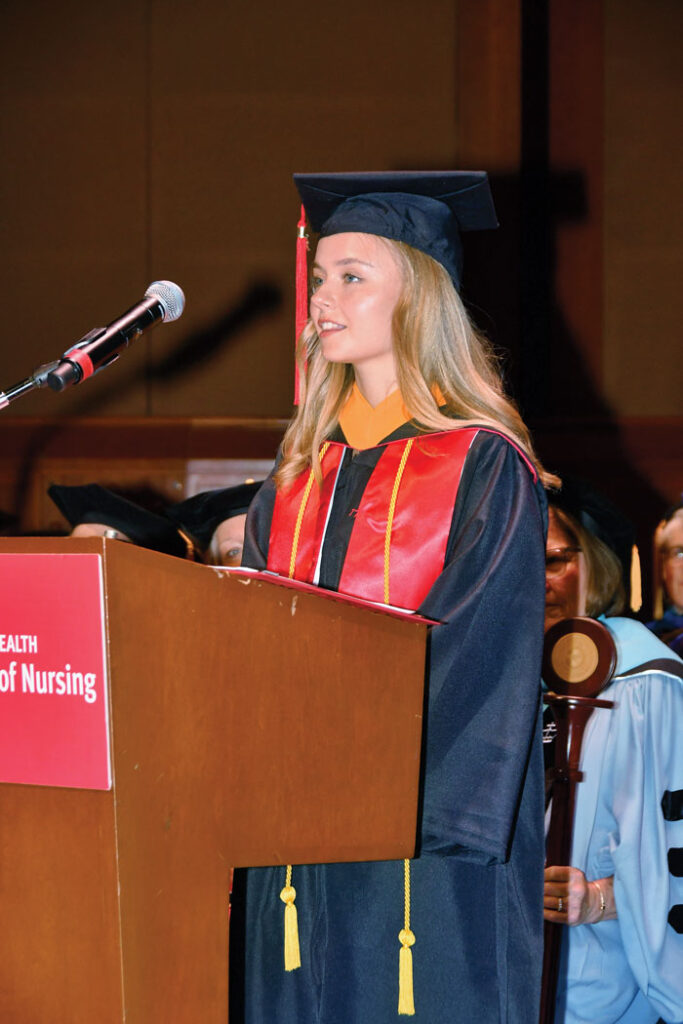
As a nursing student completing her clinical rotations, Elle Christofferson, BS, was confident in her clinical skills. Yet, when caring for patients whose primary language was Spanish, communication gaps could make even basic interactions difficult for both student and patient.
As president of the Rutgers School of Nursing Student Senate, Christofferson heard from peers facing the same challenge. So, she teamed up with a fellow Senate member to find ways to help.
One result was a new virtual workshop for students developed through a partnership among student leaders, School of Nursing administrators, and faculty from Rutgers’ Spanish department. “Communicating with Spanish-Speaking Patients” attracted more than 80 registrants and is expected to become a regular offering.
Representing undergraduates across campuses, the Senate is one of several student-run organizations in the School of Nursing. “It’s a space where students know they can speak to a peer to let their voice be heard,” says Laura Stone, MSW, associate director for student engagement and wellbeing.
Senate advocacy has led to school changes such as restructuring a course to better support student success and updating the student uniform to better suit clinical settings.
Christofferson, who graduated in May, says the experience provided lessons she’ll draw from throughout her nursing career. “I ran meetings, communicated with advisors, and fielded students’ questions and concerns,” she says. “It gave me a better understanding of what it takes to work within a large system and expanded my leadership abilities.”
Leadership development extends beyond campus governance.
The National Student Nurses’ Association (NSNA), New Jersey Nursing Students (NJNS), and the Rutgers Student Nurses’ Association (RSNA) offer opportunities for engagement at the national, state, and campus levels.
Clinical associate professor Barbara Cannella, PhD, RNC-OB, APN, is the faculty advisor for the RSNA. “Student associations and chapters mirror professional nursing associations and expose students to professional responsibilities,” Cannella says.
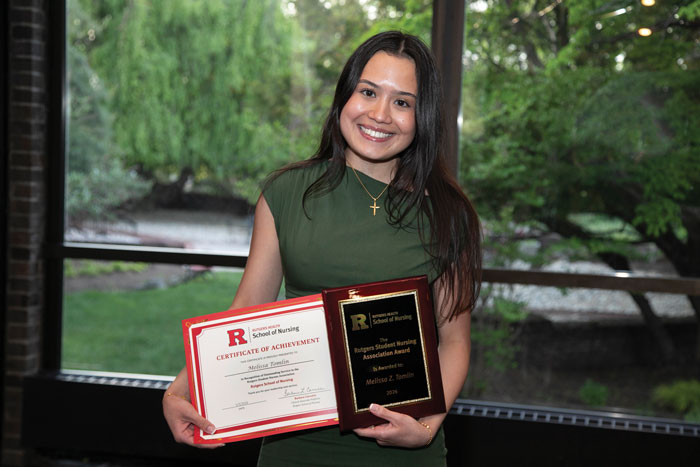
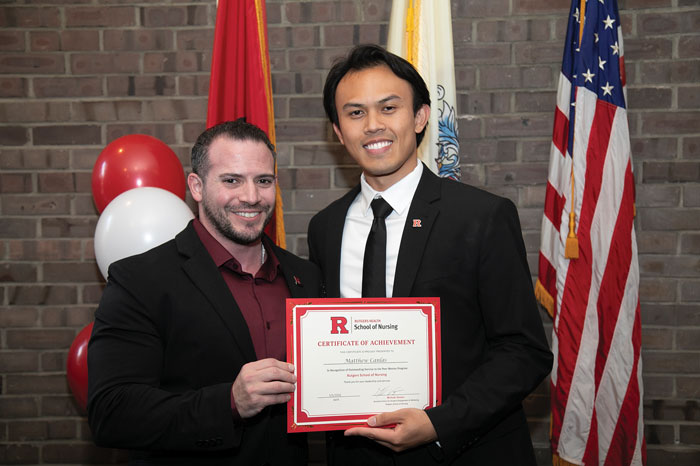
Before graduating with the class of 2026, Melissa Tomlin, BS, served as RSNA president, and Matthew Canlas, BS, was treasurer. Both also held executive posts on the New Jersey Nursing Students board.
“Organizational involvement helps nurses build networks of peers and mentors, providing opportunities to learn from one another while advocating for our profession and our patients,” says Barbara Sinacori, PhD, RN, CNE, associate professor and interim associate dean for entry to baccalaureate practice.
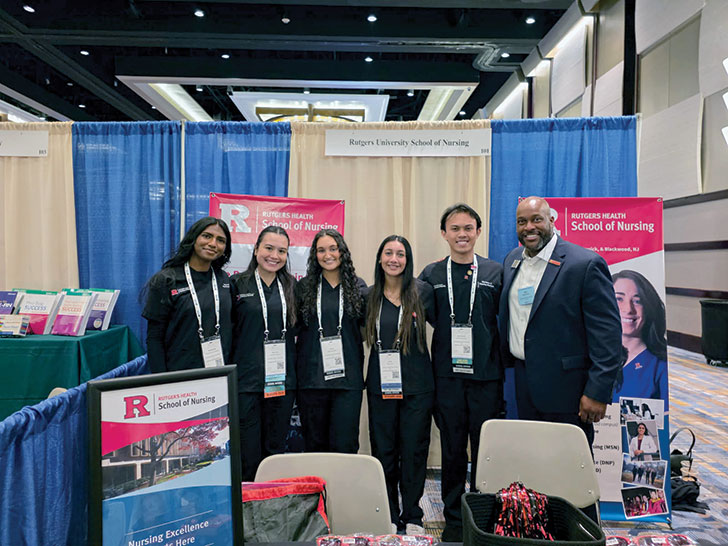
Tomlin and Canlas were among five School of Nursing students who attended the National Student Nurses Association’s 74th annual convention in Houston, Texas. They were joined by Kyle D. Warren, PhD, MAE, senior vice dean for administration and student affairs and associate vice chancellor for student affairs-Rutgers Health.
Canlas says participation in nursing organizations broadened his view of what nurses can accomplish beyond direct patient care. “It introduced me to the idea of creating change within the nursing profession,” he says.
Tomlin notes that she found similar inspiration. “Going to those conferences, meeting other leaders and other nursing students who have a passion to create change—it was an eye-opener,” she says.
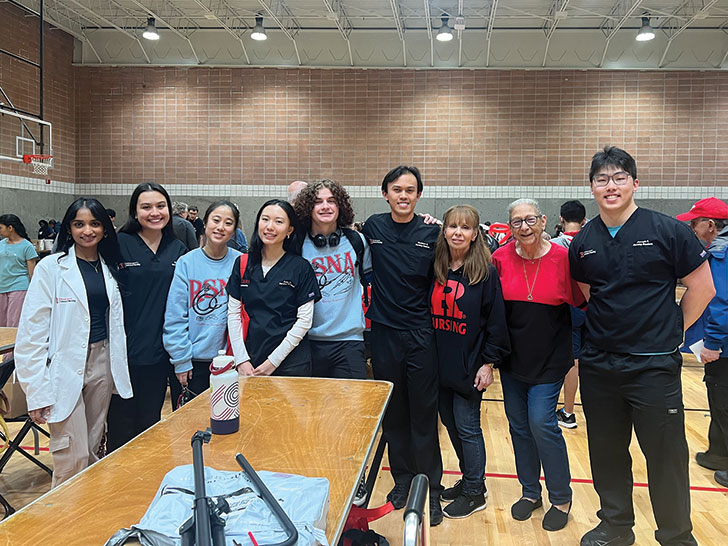
Additional leadership opportunities for students include the School of Nursing’s peer mentoring and peer tutoring programs, internships, and special committees, as well as membership in its chapter of the American Association for Men in Nursing.
School-supported leadership opportunities “prepare our students for how we expect them to lead when they leave here,” says Warren. “They are graduating with an advanced understanding of what it takes to step into an organization, to speak up for themselves, to speak out for their patients, and to lead from day one.”